

Electoral Math -- Harris Enters The Fray
A program note is necessary, to begin with here. I almost wasn't going to even bother with the whole "Electoral Math" series this year, because it would have been so depressing to try to cheer President Joe Biden's chances on while watching Trump flip state after state. So up until very recently, I hadn't even started collecting the data or doing the charts or anything.
Of course, that all changed three weeks ago.
So welcome back to our Electoral Math column series again! This marks the fifth presidential election we will have provided this service, I should mention. This year, for obvious reasons, we are only going to track the data from late July onwards. Our charts will begin two days after Joe Biden exited the race, or Tuesday, July 23rd. This was the point where Donald Trump hit his maximum in state-level polling and things looked the grimmest for the Democrats. But, of course, that would all soon begin to turn around....
Because now the race is Vice President Kamala Harris versus Donald Trump, and everything has changed as a result.
But before we get to the data, a few introductory comments are necessary. The last time we did this, back in 2020, we prefaced our introductory column with a long explanation of the shortcomings of polling, and rather than repeat it all here we would just direct you to re-read the first part of that column. In short, polling isn't perfect, but it's really all we've got to go on.
As usual, what we set out to do here is to track the state-by-state polling on a daily basis, so you can see how the political landscape shifts over time. We're still not aware of anyone else who bothers to track the data in such a fashion, but it seems a rather obvious thing to do. As always, we are happy to get all our data from the fantastic Electoral-Vote.com site, which has its own series of graphs and interpretations that are well worth checking out. This site has been consistent over the past five election cycles, and stands as a great resource for poll-watchers.
And due to all the data-entry required for this initial column, we haven't quite gotten all the charts working again for this cycle -- just the basic ones -- so we'll have more interesting stuff for you in further installments. OK, that seems to be enough introduction, so let's get to where the race stood three weeks ago and where it stands now.
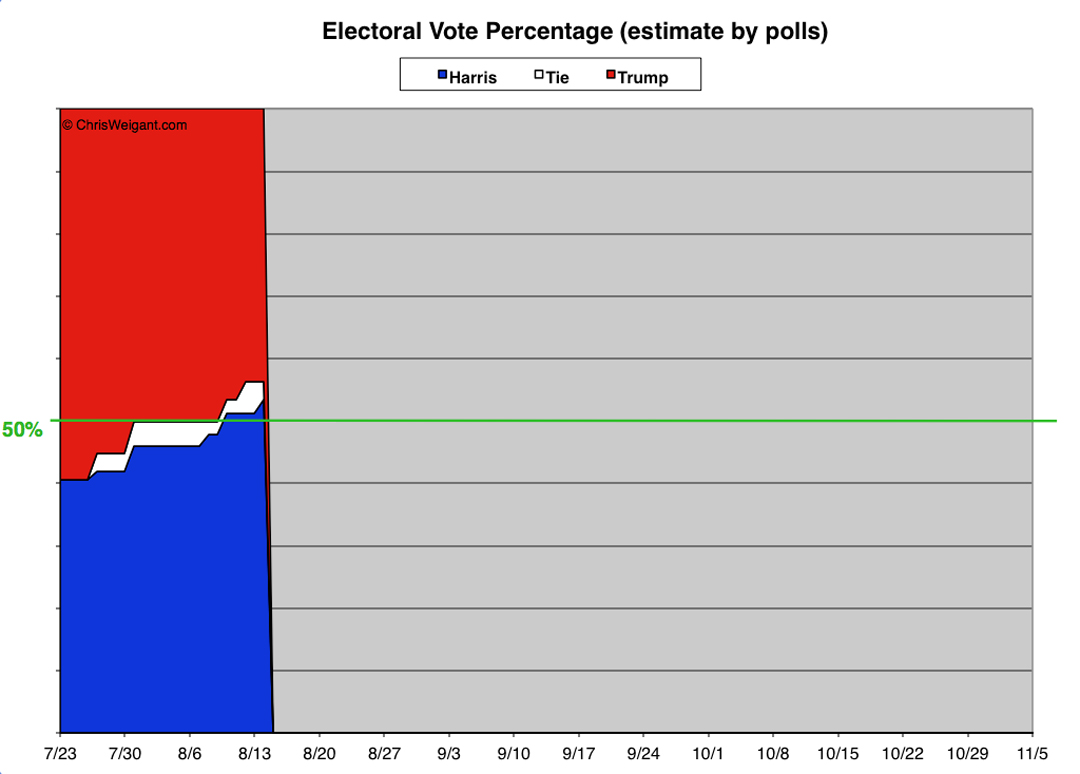
Our first chart is a measure of the percent of Electoral Votes (EV) that the two candidates would have if the election were held today and all the polls were perfectly accurate. Kamala Harris's numbers start from the bottom and are in blue, and Donald Trump's numbers start from the top and are in red. Any white space in between are states which are currently tied in the polls. If the blue line is above the 50 percent mark, Harris has the advantage. If Trump's red line is below 50 percent, then he has the advantage.
The last two charts show the relative strength of each candidate's support. Polls which show a 10 point lead or better are considered "Strong," while a gap of between 5 and 10 points is "Weak" and a lead of under 5 points is only "Barely" in their column.
[Click on any of theses graphs to see larger-scale versions.]
As you can see, there is a definite sense of momentum, and it's heading in one direction. Trump started with 320 Electoral votes (EV), but that domination has pretty much collapsed now, down to only 235 EV. Harris started at a real disadvantage (remember, the earliest polls on this chart were still measuring Biden's popularity), but has built steadily on it since and is now over the 270 mark. Harris began at only 218 EV, but has now risen to 287 EV -- 17 more than is needed to win. Harris now has 53 percent of the Electoral Votes while Donald Trump only has 44 percent. Trump lost 85 EV in three weeks' time, and Harris picked up 69 of them (with North Carolina's 16 currently tied).
Over the past three weeks, almost all the movement has been towards Harris and away from Trump. In fact, there's only one exception to this. Ohio firmed up for Trump, going from Weak Trump to Strong Trump about two weeks ago. Other than that, it's been bad news for Team Trump and good news for Team Harris.
Harris has seen one state firm up for her (Minnesota, which went from Barely Harris to Weak Harris and will quite likely move to Strong Harris once polls are taken which reflect her new running mate...), one state move into "Tied" territory (North Carolina, from Weak Trump), and a whopping seven flip entirely from Trump to Harris.
That's an astounding amount of movement, in such a short period of time -- but again, it reflects the change from Joe Biden being on the ticket to Kamala Harris more than anything else.
But let's take a deeper look into each candidate's relative levels of support. First up, Trump's chart:
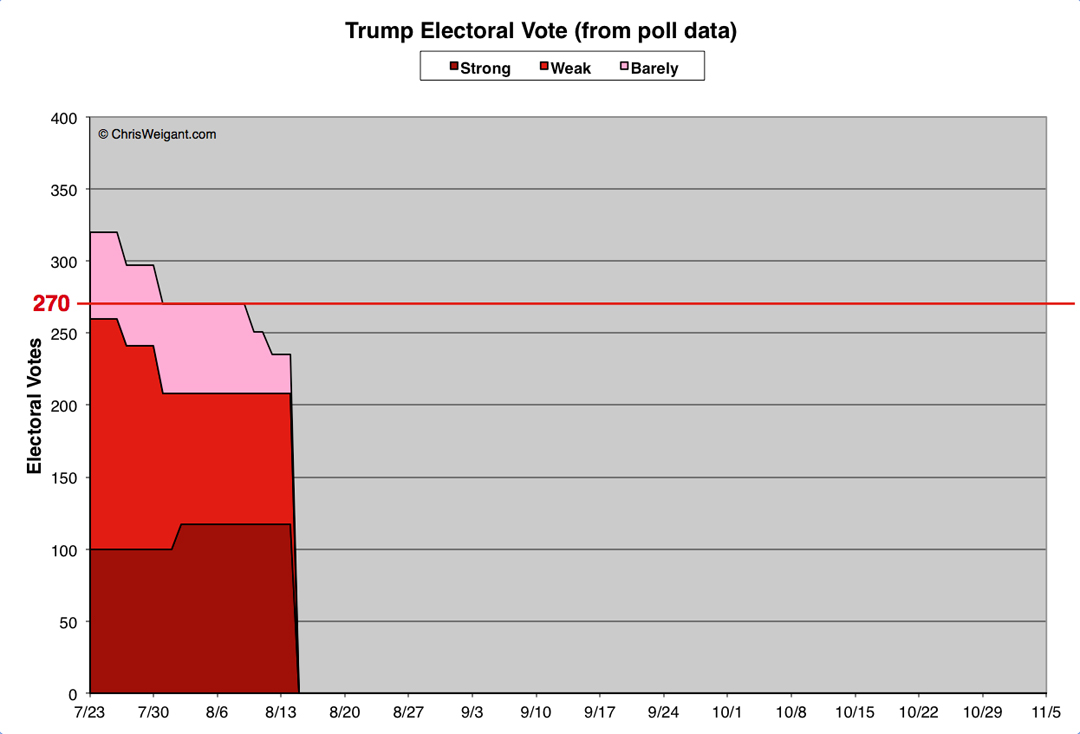
As previously mentioned, Trump's numbers haven't totally collapsed, but they certainly have crumbled of late. At the start, Trump was riding high -- with 320 EV, which is a full 50 EV above what he would need to win. That's pretty impressive, and that goes for any Republican in a presidential race, these days. But then the Kamala effect began to take hold, and it's been downhill for him ever since. Now Trump is down to only 235 EV -- a loss of 85 Electoral Votes. That's an immense change, in such a short period of time.
However, as stated, he hasn't totally collapsed. Strength in these polls is best measured by "Strong plus Weak," and on that measure Trump's not doing too badly. He started at a whopping 260 EV in these two categories (combined), which is higher than any Republican has ever managed since I started doing these columns in 2008 (with John McCain).
Trump's Strong numbers improved from 100 to 117 EV, with Ohio going Strong for him halfway through. His Weak numbers, however, have declined precipitously. He started off with 160 EV in Weak Trump, but that has now fallen to only 91 EV. That's a dropoff of almost 70 EV, which should be concerning for Team Trump.
In quick succession, Trump saw several states slip out of the Weak Trump category: Pennsylvania (down to Barely Trump and now flipped to Barely Harris), then on the last day in July Trump lost Nevada (flipped all the way to Barely Harris), Arizona (also flipped to Barely Harris), and North Carolina (down to Barely Trump, and then to Tied).
But as mentioned, Trump is still in stronger shape than he was at this point in either 2016 or 2020. The red states are pretty solidly behind him, and that doesn't appear to be as susceptible to change as it was in earlier years. It's the battleground states where Trump is rapidly losing support, but he'll need them to win.
Having said all of that, let's take a look at how Kamala Harris is doing:
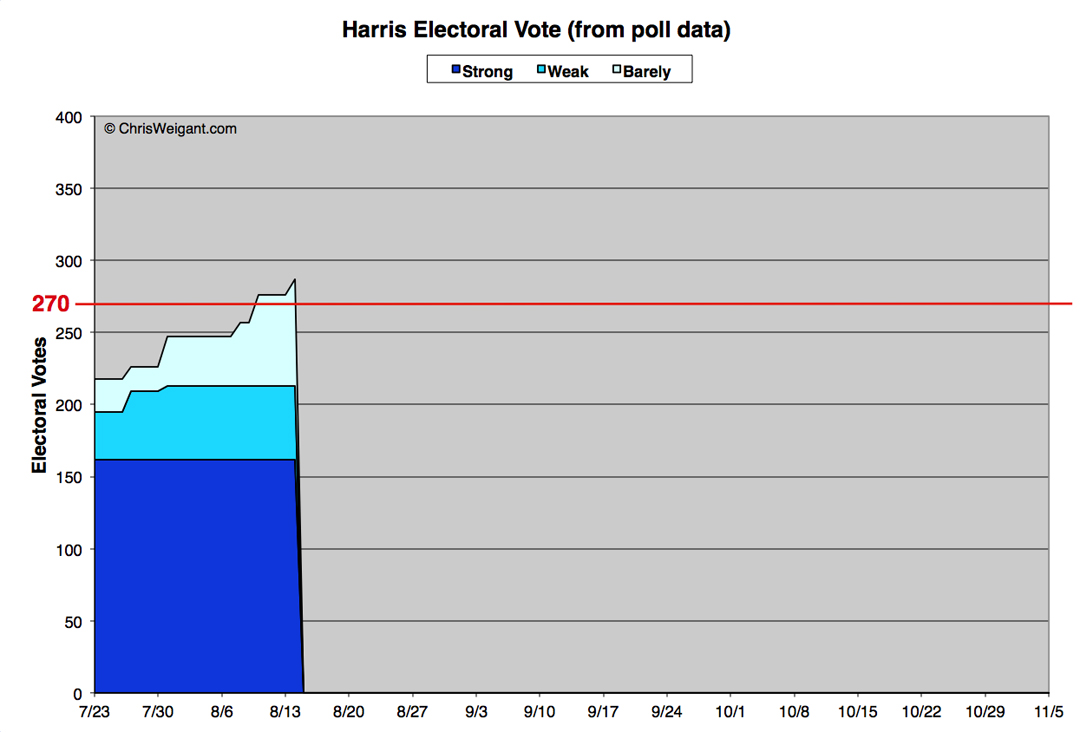
Harris has certainly turned things around in the short time she has had so far. She started at only 218 EV, a whopping 52 EV fewer than is needed to win. But since she became the Democratic presidential candidate, the polls have taken a dramatic turn for the better. This morning a new poll from Arizona was posted which put the state into her column, which now leaves her with 287 EV, well over the 270 EV needed to win.
Here's a wrap-up of the movement towards Harris in the past three weeks: Nevada went from Weak Trump straight to Barely Harris; Wisconsin, Michigan, and (today) Arizona moved from Barely Trump to Tied to Barely Harris; Pennsylvania moved from Weak Trump to Barely Trump to Barely Harris; and both New Hampshire and Maine moved from Barely Trump all the way to Weak Harris.
Breaking things down by category, Harris has not improved any in her Strong category, but this isn't too surprising since there haven't been polls in every state since she took the reins from Biden. She started with 162 EV here and it hasn't changed a bit.
In her Weak category, Harris has seen some improvement. Minnesota was polled during the first week Harris started running, and moved up from the Barely column. This, however, was before Tim Walz was named her running mate, so I fully expect the state to wind up as Strong Harris in the next poll. Harris also picked up both New Hampshire and Maine (which both started as Weak Trump), leaving her with a total of 51 EV in the Weak category.
Harris's "Strong plus Weak" number has improved as a result, going up from 195 EV at the start to 213 EV today. This is a decent showing for this early in the race, but she's still got room for improvement here. Harris currently has six states in the Barely category (Nevada, Arizona, Wisconsin, Michigan, Pennsylvania, and Virginia), and any of them firming up to Weak would certainly improve her chances. Her Barely numbers have shot up, from only 23 EV to now stand at 74 EV, but she's only winning these states by less than five points each, so they all have to be seen as still at risk for Harris.
My Picks
Moving on from just raw polling data, this is the part where my gut feelings enter into the equations. It's easy to get drawn into the polling map and make assumptions, but one thing to always keep in mind is how old the polling data from each state actually is. Check out each state's individual state graphs to see how many polls have been conducted in each state, and how recent they are. Down at the bottom of this column is a section for data, where I list the states which have not seen any recent polling at all, as well.
I do have to admit that since this is the first column in the series, there isn't a ton of data to base guesses on, so a lot of my categorizing this time around will be fairly arbitrary (in other words, feel free to disagree with lots of these picks). Over time, though, as more data comes in, hopefully my gut feelings will align a lot closer to the reality on the ground.
I divide all my picks into "Safe," "Probable," and "Leaning" for each candidate, with a final "Too Close To Call" category at the end. So let's take a look at where things stand.
Likely States -- Harris
Safe Harris (16 states, 200 EV)
Since this is the first column, we'll list all the states in each category (in future installments, we might just note which states have recently moved, but the full lists are always available down in the data section at the end).
I started with the states all polling strongly for Harris, all of which seem pretty safe bets: California, Connecticut, Delaware, D.C., Hawai'i, Illinois, Maryland, Massachusetts, New York, Oregon, Vermont, and Washington. But then I have to add a few more in, which have just not had any recent polling but would almost certainly show strong support for Harris if they were polled: Colorado, New Jersey, and Rhode Island. I am also going to be optimistic and add in Minnesota, since with their governor on the ticket the state seems almost certain to wind up in the Democratic column on Election Day.
Probable Harris (4 states, 26 EV)
Since we've already moved Colorado, Minnesota, New Jersey, and Rhode Island up a notch, there are only three other states which by all rights should be in this category: Maine, New Hampshire, and New Mexico. But I am going to be optimistic and also add Virginia here, since they haven't had been polled after Biden dropped out. I would expect the enthusiasm shown elsewhere will also put Virginia into a safer spot soon, so I am jumping the gun and adding it in to Probable Harris for now. Hopefully, if all of these states are polled in the coming days and weeks, a few of them will also move upward to being considered Safe Harris as well.
Likely States -- Trump
Safe Trump (19 states, 123 EV)
There are 15 states where Trump is polling strongly, and they should all be considered safe for him: Alabama, Idaho, Kentucky, Louisiana, Missouri, Montana, Nebraska, North Dakota, Oklahoma, South Carolina, South Dakota, Tennessee, Utah, West Virginia, and Wyoming. There are also three more that are polling a bit weaker but should be considered safe bets for Trump as well: Arkansas, Kansas, and Mississippi. And there is one which hasn't been polled since the real start of the race which somehow wound up very weak for Trump but should easily be considered a safe state for him -- Indiana.
Probable Trump (4 states, 66 EV)
These are somewhat arbitrary and heavily reliant on gut feeling, but in the end they'll all likely wind up voting Republican. Alaska and Texas aren't polling as strongly as they really probably should, and while Iowa is indeed polling strongly I have to wonder whether Tim Walz might just eat into Trump's lead in this next-door-to-Minnesota state (I realize I am probably wrong about that, though). And Ohio saw one rather weak poll recently that made me pause, even though it is officially polling very strongly right now, so I included it here too.
Tossup States
Lean Harris (3 states, 44 EV)
Speaking of arbitrary, this entire section is nothing more than me throwing darts at a wall right now. There just isn't enough polling data to really tell about any of these, if truth be told. So I just went purely with gut feelings for which state wound up where. There are three states that only very recently flipped to Harris that I feel pretty good about, so I'm going to list them as Lean Harris for the time being: Michigan, Pennsylvania, and Wisconsin. You'll note that these are all the "Big Blue Wall" states, which is probably driving my own optimism.
Lean Trump (1 state, 30 EV)
This should likely be up a category for Trump, but again there are outlier polls showing the race might be closer than anticipated (plus the abortion referendum on their ballot this year), so for now I am going to list Florida as merely Lean Trump.
Too Close To Call (4 states, 49 EV)
And finally the four states where anything could happen. Arizona and Nevada have only recently flipped to Harris, but they could just as easily flip back with another poll. North Carolina just moved to Tied, so again anything could happen there (we'll have to wait for further polling to see). And Georgia is currently in Trump's column, but only by a single point, so it could flip to Harris at any time.
Final Tally
Things are very much up in the air right now, since there just hasn't been enough time to build up enough data to indicate true trends. But it is undeniable that the wind is now at Kamala Harris's back and that Trump is on the ropes. Harris has pulled off the monumental feat of entirely turning this election around in an incredibly short period of time, but her hold on the crucial states it will take to win is still pretty tenuous.
Harris has a lead in the Safe and Probable categories, chalking up 226 Electoral Votes from 20 states. But this still leaves her 44 EV short of the total necessary to win. Donald Trump on the other hand only has 189 EV from his Safe and Probable states, but this hinges on a very arbitrary call by me to leave Florida out of his list.
When you add Trump's one Lean state (Florida) back in, he winds up with 219 EV. And again, due to my arbitrary optimism in assigning all the Blue Wall states to Lean Harris, when you add up all her numbers, she winds up with exactly the 270 EV needed to win.
This is still an incredibly close race, folks. Harris has the momentum currently, but anything could happen and neither candidate right now is in what you would call a comfortable position.
[Full Data:]
(State electoral votes are in parenthesis following each state's name -- and please note a lot of these have changed since 2020, due to the reallocation of House seats after the Census. Washington D.C. is counted as a state, for a total of 51.)
Kamala Harris Likely Easy Wins -- 20 States -- 226 Electoral Votes:
Safe States -- 16 States -- 200 Electoral Votes
California (54), Colorado (10), Connecticut (7), Delaware (3), Hawai'i (4), Illinois (19), Maryland (10), Massachusetts (11), Minnesota (10), New Jersey (14), New York (28), Oregon (8), Rhode Island (4), Vermont (3), Washington D.C. (3), Washington (12)
Probable States -- 4 States -- 26 Electoral Votes
Maine (4), New Hampshire (4), New Mexico (5), Virginia (13)
Donald Trump Likely Easy Wins -- 23 States -- 189 Electoral Votes:
Safe States -- 19 States -- 123 Electoral Votes
Alabama (9), Arkansas (6), Idaho (4), Indiana (11), Kansas (6), Kentucky (8), Louisiana (8), Mississippi (6), Missouri (10), Montana (4), Nebraska (5), North Dakota (3), Oklahoma (7), South Carolina (9), South Dakota (3), Tennessee (11), Utah (6), West Virginia (4), Wyoming (3)
Probable States -- 4 States -- 66 Electoral Votes
Alaska (3), Iowa (6), Ohio (17), Texas (40)
Tossup States -- 8 States -- 123 Electoral Votes:
Tossup States Leaning Harris -- 3 States -- 44 Electoral Votes
Michigan (15), Pennsylvania (19), Wisconsin (10)
Tossup States Leaning Trump -- 1 State -- 30 Electoral Votes
Florida (30)
Too Close To Call -- 4 States -- 49 Electoral Votes
Arizona (11), Georgia (16), Nevada (6), North Carolina (16)
Polling data gaps:
[Note: during the primaries, Zogby conducted a poll in every state on April 21, with the sole exception of Washington D.C., which has had no polling at all this cycle. But I thought it'd be more useful to keep track here of which states have not been polled since Joe Biden dropped out of the race.]
No polling data with Harris -- 35 States
(States which have not been polled since July 21st, with the dates of their last poll in parenthesis.)
Alabama (4/21), Alaska (4/21), Arkansas (4/21), California (7/2), Colorado (4/21), Connecticut (4/21), Delaware (4/21), Hawai'i (4/21), Idaho (4/21), Illinois (4/21), Indiana (4/21), Iowa (6/14), Kansas (4/21), Kentucky (4/21), Louisiana (4/26), Maryland (6/20), Massachusetts (7/18), Mississippi (4/21), Missouri (6/19), Nebraska (4/25), New Jersey (4/21), New Mexico (6/14), North Dakota (4/21), Oklahoma (4/21), Oregon (4/21), Rhode Island (6/14), South Carolina (4/21), South Dakota (5/13), Tennessee (5/9), Utah (6/7), Vermont (4/21), Virginia (7/15), Washington D.C. (--), West Virginia (4/21), Wyoming (4/21)
-- Chris Weigant
Follow Chris on Twitter: @ChrisWeigant


Comments for this article are closed.